Episode Transcript
[00:00:00] Speaker A: Think nuclear power plants, think water treatment plants. You could have one of these robots stationed in and then a qualified operator can embody it, perform the operations needed to keep the facility infrastructure running and be done with the day.
[00:00:20] Speaker B: Hello everyone and welcome to the Robot Industry podcast. My name is Jim Beretta and I'm your host. And for this edition of the podcast I'm super excited to have Tarek Rahim here and he is the co founder and CEO of Mercy Robotics. And we're here at Windsor Essex Emerging Technologies in Automation and Mobility Conference. And Tarek, hey, welcome to the podcast and glad to see you here.
[00:00:43] Speaker A: Thanks for having me, Jim.
[00:00:45] Speaker B: So Tarek, you're in kind of an interesting area and very limited area here in Canada. You are manufacturing humanoid robot. Can you tell us a little bit about it?
[00:00:55] Speaker A: So we are Mercy Robotics. We are one of the few humanoid companies in Canada and we've been designing, developing and assembling humanoid robots since 2017.
[00:01:08] Speaker B: So that's super exciting. And how did you get into this industry?
[00:01:12] Speaker A: Actually it's a bit of an odd story. I've always been fascinated with how things work. And when I was in high school I had an electronics class and I did a robot project. It was a little hexapod. Yeah, I built everything from the ground up on that robot. Fell in love with developing firmware, motion controllers, designing circuit boards, and just the variety of different applied sciences in robotics was really appealing to me because I'm a bit of a generalist. I like to figure out how things work and robotics was like the one field that could combine all of my passions and interests. So that's kind of how I got into it.
[00:01:50] Speaker B: So tell us a little bit about Mercy Robots and how you got started in that too. Because your journey's been. You've been about seven or eight years now, right?
[00:01:58] Speaker A: Yeah, we've been doing this long before around the humanoid industry.
It certainly wasn't a cool space to be in when we got started. But fortunately people are understanding the applications and how transformative the technology could be. So I got started. I met my co founder, Robert Ings at a hackathon. He has another company where he designs and sells these.
They're little credit card sized computers, they're called system on modules and they go into a wide variety of commercial products that are used in aerospace, medical, defense, you name it. And he showed me the board and I kind of, I have a good understanding of electronics design and was blown away by just how sophisticated his product was. The work involved in creating such a complicated PCB in such a small, miniature form factor. He was into robotics, I was into robotics, and we both had moms that were getting up in age and we thought, why not develop a robotics company around senior care and improving access to care. So that's the initial market we targeted.
Turned out to be much more challenging to get into that as a first market. So we pivoted a little. But our passion of trying to develop technologies to help people and make the world a little better has always been our mission.
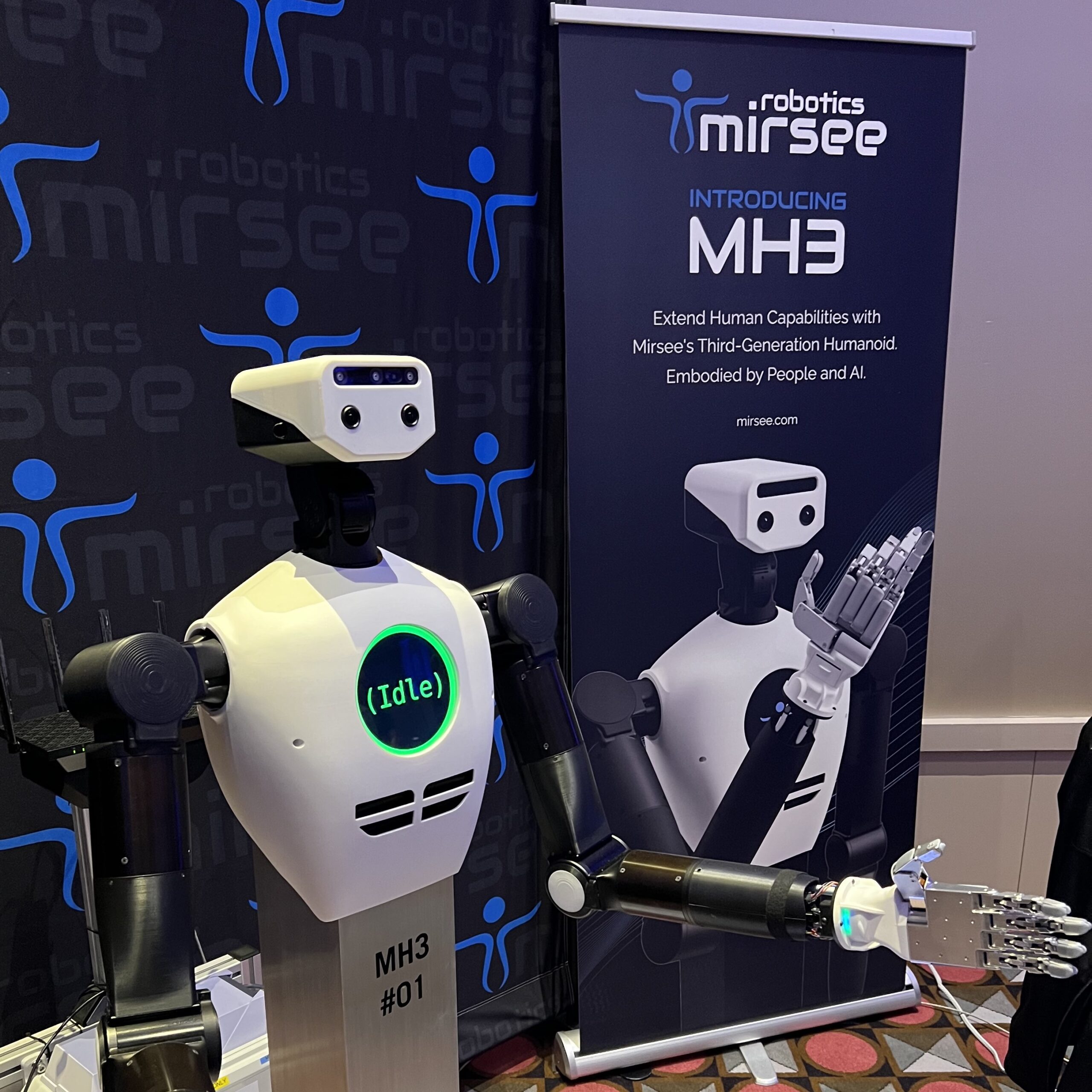
[00:03:23] Speaker B: So your robot is called MH3. So tell me a little bit about MH3. How would I know that this is a mercy robot?
[00:03:29] Speaker A: Well, it's in the name Mercy Humanoid 3. We are not clever with names. We are very much technical founders and people have asked us endlessly what's the name of the robot? And we just can't give them names. We give them numbers. But we recently came up with the naming convention image and then generation number because it's simple and works for us. And at the end of the day, they're machines and we don't want to be giving them human like names.
[00:03:57] Speaker B: Yeah, yeah, no, that's totally cool. So what are conversations with your customers or your prospective customers like?
[00:04:03] Speaker A: They are varied and they change quite a bit. So a few years ago, AI was nowhere near as capable as it is today. So the only realistic use case for our products was teleoperation or human embodiment. And there's a niche of industries that a teleoperated humanoid would make sense for. So this turns out to be mostly critical infrastructure.
So think nuclear power plants, think water treatment plants, work site that is either very remote, far away or hazardous. You could have one of these robots stationed in and then a qualified operator can embody it, perform the operations needed to keep the facility or infrastructure running and be done with the day. So it's about moving skilled human labor to remote or hazardous work sites.
[00:04:55] Speaker B: Can you tell me a little bit, Tarek, about the robot hand that you've designed?
[00:04:59] Speaker A: Yeah. So that hand we're very grateful for.
Canada's Department of National Defence, they helped fund the R and D to develop the hand that we have today. Our robots, including the hand, are designed to deliver the degrees of freedom or the motions that actually matter. We're not trying to go for ultra lifelike human mimicry. We're not trying to capture finger motions that don't add value. We're focusing on the core motions that matter. So for the fingers, it's extension flexion, for the thumb, it's opposition and extension flexion. So by focusing on what matters, we can increase the power and performance of the specifications that customers need.
[00:05:46] Speaker B: And so your customers typically then are like in these rough environments and you're doing a lot of manipulation. Pick and place. What are the kinds of applications are you doing?
[00:05:56] Speaker A: We've done everything under the sun.
So we've used our robots to operate power tools, flick switches on control panels, turn valves. Anything you could imagine being done in a power generation facility or a water treatment plant.
We're doing tasks that technicians and operators would be doing on site.
[00:06:20] Speaker B: One of the things you're tackling in robotics and automation is pick and place. Right. So do you see MH3 being used in like automotive assembly plants or where do you see that?
[00:06:32] Speaker A: Yeah, we have some pilot projects where we're targeting the most basic, easily attainable autonomy tasks.
So there's, you know, pick and places. It can range in complexity depending on the objects and variety that you're dealing with. But we're, we're targeting, we found customers that have applications where it's a limited number of objects, they're relatively easy to grasp and we can realistically deliver an autonomous solution for their needs. So that's what we're targeting first, as well as toad handling and environment scanning.
[00:07:10] Speaker B: So what are some of the questions that your customers ask you about MH3?
[00:07:14] Speaker A: The first question is, when can I buy one? So we're encouraging customers to pursue pilot projects because at this time there's nothing that is commercially ready. We're still at the pilot stage as an industry and we need to iterate through the product and get the final bucks out and the reliability and speed up to the point where customers can derive real value. So I'm very upfront about what's possible today and what will be possible tomorrow. This is definitely an industry people need to pay attention to and start investing the time and research because it is coming fast and the sooner you're ready for it, the better positioned you're going to be.
[00:07:55] Speaker B: And you see mercy. Sorry, you see MH3 working with people, correct?
[00:08:00] Speaker A: Yeah, yeah. So our humanoids are essentially like, you can think of them as a pair of cobot arms. Vision system on an amr. Right. These are designed to tolerate human interaction. They, you know, they operate under impedance control. So you can, somebody can go up and push the robot and it's not going to resist.
It'll move away. So it's important for us to deliver a solution that doesn't, you know, if it doesn't counter people, it doesn't hurt them, and it just gets out of the way and doesn't become a liability.
[00:08:37] Speaker B: And you see that future of robotics and people working together as like a very robust thing, correct?
[00:08:43] Speaker A: Oh, yeah, yeah. Humanoids, like, the form factor is, is so it's wonderful because it's just a seamless integration into any environment. Because the facilities, environments, equipment, tools around us are all designed by humans for human use.
So if you have a robot that mimics the human form, there's zero customization that needs to be done. It's ready, deployable in your facility today. You don't have to customize your environment to support the robot. These robots adapt to whatever environment they're.
[00:09:20] Speaker B: In, you know, and I think there's a general fear of robots by humans. And I think having a machine that looks like us, I think there's a certain comfort.
[00:09:28] Speaker A: I don't fully understand human psychology too much.
I see them as machines. A lot of people don't.
They attribute, you know, sentience and like, you know, lifelike characteristics to them. But the perception's definitely there. For us, it's more important to deliver the human versatility. That's why we mimic the range of motion. The visual appearance really isn't that important. We need robots that can do the jobs humans can do. Whether they have a human like face and hair, that's all irrelevant. We need the versatility and intelligence that humans have, and the human form is important for that.
[00:10:08] Speaker B: And will you have AI in MH3 at some point?
[00:10:11] Speaker A: Yes, yes. So we're just developing our autonomy architecture right now.
For the longest time, the only realistic solution was teleoperation or human embodiment. But now with all the advances in modern multimodal AIs and the entire Nvidia Isaac Lab software stack, they've really developed the suite of tools to create autonomous solutions for humanoids. So the barrier to entry is much lower now, and it's going to reach a point where you basically tell the machine what you want it to do in plain English.
It understands the environment, objects around it, and it determines the tasks needed to get the job done. So no programming, nothing. It'll be like a human worker.
[00:11:02] Speaker B: Tarek, I've seen you at a lot of trade events and seeing you out and about, which is great. And I took some selfies with MH3. I understand you also have a working arrangement or agreement with Eclipse Automation.
[00:11:18] Speaker A: Yep, that's correct. We recently entered a collaboration agreement with Eclipse. They are a phenomenal provider of custom industrial automation solutions and they have deep domain expertise in developing the assembly and manufacturing lines to produce everyday objects we see around us.
So having them is incredibly strategic because they are very well versed in the entire Nvidia Omniverse stack. And they can provide us with not only the compute, but the engineering talent and source files to train our models to perform autonomous tasks in a real environment.
[00:12:05] Speaker B: Tarek, I understand that you're doing some work with Eclipse Automation.
[00:12:10] Speaker A: That's correct. This is actually a very strategic partnership for us because Eclipse Automation brings decades of expertise in designing and integrating custom automation solutions for some of the world's most complex industries.
And that experience aligns with us perfectly. As you know, we've achieved this humanoid design that we want to get into production, and the next stage of growth is manufacturing. And there's so many challenges involved in scaling and producing products in volume.
They dramatically de risk all that. So having their expertise and background is super valuable for us.
They also have deep knowledge of the whole Nvidia Omniverse stack. And this is so essential for us because that data and those assets are used to train AI models and test systems in digital environments before physical deployment. And these tools are essential in developing humanoids that are both intelligent and reliable.
[00:13:14] Speaker B: You know, and I'm envisioning having lots of these robots at the end of line for all these robot integrators such as Eclipse. So I think that's really awesome. And. And you're busy raising money because these things cost a lot of money to do and growing your skills and doing all kinds of hiring. So that's exciting news.
[00:13:31] Speaker A: Yeah, yeah. We've actually, this year has been incredibly fortunate for us. We've received a ton of investment offers, and right now we're quite good. We are planning to launch our Series A in six to eight months. And, you know, if there's investors that are listening that are interested in the humanoid space and would like to contact me, feel free to do so. We're always open to partnering with the right people.
[00:13:57] Speaker B: Yes. So if they are interested, they just go to their Mircee website. And Mirce is M I R S E E Robotics, Inc. Correct.
[00:14:06] Speaker A: Yeah, that's the company name. The website's just mercy.comm I r s e dot com.
[00:14:10] Speaker B: Okay, great. And when you're not. When you're not building robots and AI systems and hiring staff, do you have any hobbies? Do you like to. Is there anything that you like to do or are you just like.
[00:14:20] Speaker A: Well, I watch a lot of YouTube, but fortunately it's like engineering videos. But yeah, I mean, I do have a personal life and it used to be I spent all my life just building robots. I went through a period of burnout and I've learned to, you know, find meaning outside of work and developed a personal life. And it's so important to have that balance because if you're solely focused on work or solely focused on family, then you're missing out on having a balanced, healthy.
[00:14:55] Speaker B: Well, congratulations on everything that's happening to you. And I think that goes to your drive and perseverance and having that innovation spirit. And you're based in Cambridge, Ontario, correct?
[00:15:04] Speaker A: That's correct. Yeah.
[00:15:05] Speaker B: Yeah. Listen, thank you very much for coming onto the podcast. I hope to visit, revisit you in a year and see kind of where you're, where you're at and what you're doing and who you're doing with.
[00:15:14] Speaker A: Sounds great. Thanks so much, Jim. Thanks, Tarek. Take care.