Episode Transcript
[00:00:00] Speaker A: Yeah, these robots are fully made in North America here in Canada.
[00:00:11] Speaker B: Hello everyone and welcome to the Robot Industry Podcast. My name is Jim Beretta and I'm your host. And I'm pleased today to have Stan Gleiser, who's the director of strategic partnerships, integrators and OEMs for mecademic industrial robots. So Stan Gleiser is a director of strategic partnerships, integrators and OEMs at Mechademic robots. He has a background in mechatronics and has worked with industrial robots for the past 12 years in aerospace and automotive with a focus on high precision applications around vision and force feedback. Stan has always wanted to work for a robot oem, so when he heard about a robot OEM manufacturer in Montreal, he was thrilled to join Mechademic. For those people who don't know Mecademic, but we're going to have Stan introduce them. They develop and manufacture the world's smallest and most precise six axis industrial robot arm. But they also have other robots as well. So welcome Stan and thanks for joining me.
[00:01:00] Speaker A: Thank you Jim, for having me.
[00:01:01] Speaker B: And can you tell us, our audience, a little bit more about Mechademic and styles of robots that you have?
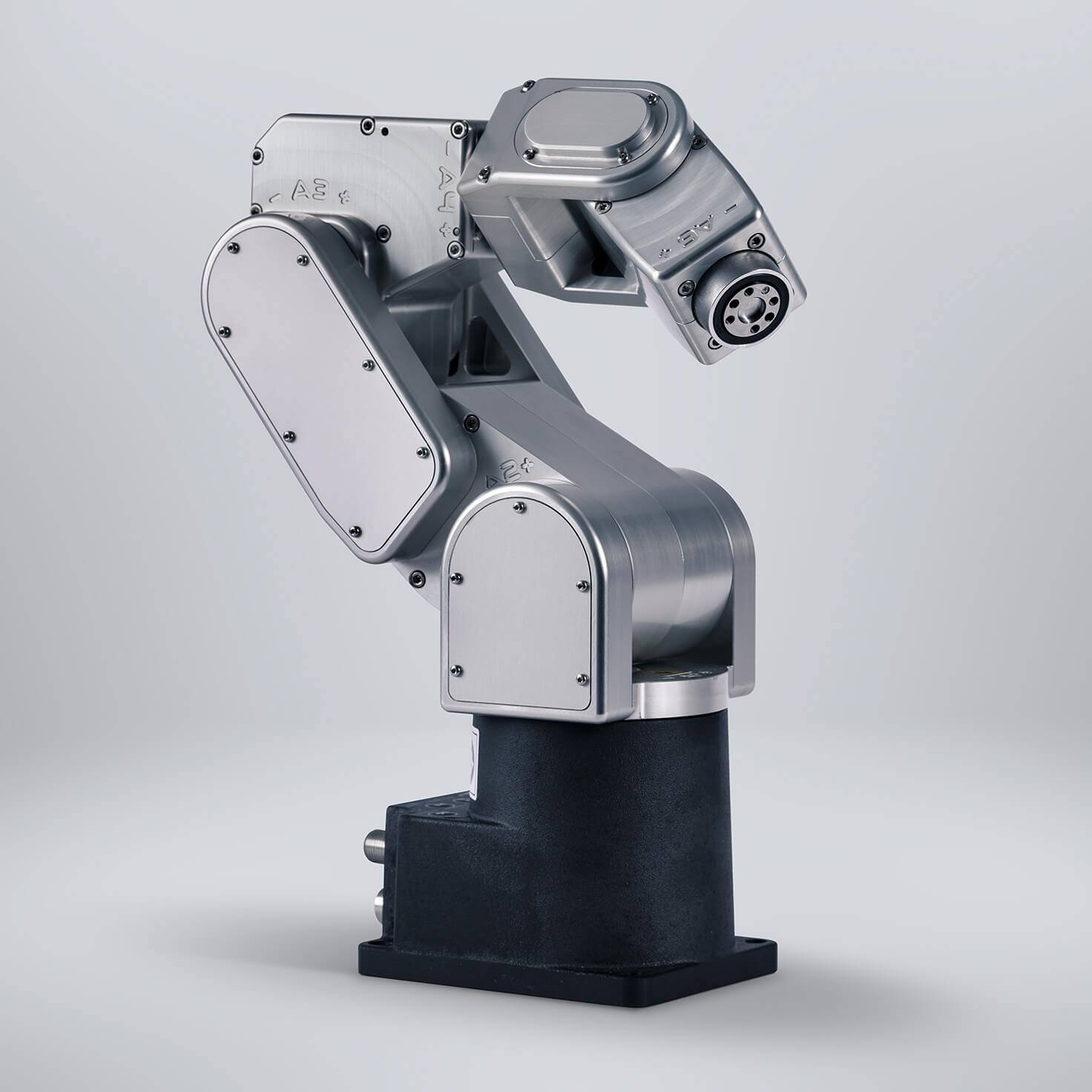
[00:01:07] Speaker A: We make a robot arm. So that's our core product. We have a six axis robot arm, but it is much smaller than you would expect. So you know, you can see it a little bit in the background. But to give you an idea, it's about the size of a sheet of paper when it's folded down. So very, very compact robot arm. So that's our six axis robot arm. And a couple of years ago we released a SCARA robot as well. We focus on smaller parts, so anything under 1kg about. So we specialize in that. We specialize on very compact robots, very, very precise robots as well. So that's, that's where we're trying to fit into the market. So we're not trying to compete necessarily with the bigger guys with Fanuc or abb.
[00:01:49] Speaker B: So mechademic robots are very noticeable at trade shows and in real life. And so as you mentioned, they're, they're reasonably small. Right. You can carry them around. Like you sometimes see some of your sales reps carrying around a trade show, correct?
[00:02:02] Speaker A: Yeah, absolutely. I mean they're noticeable because we bring usually quite a few of them to a trade show as well. Just because it's much easier for them for us to transport them around.
Yeah, we have carrying cases you could put them in. Carry on. So our sales guys or Apps guys could travel with them very easily. So that is quite specific to what we do.
[00:02:21] Speaker B: And also mechadapic robots are different from a controls, systems architecture. And there's no external control pendants, correct?
[00:02:30] Speaker A: Exactly. So we actually put the controller in the base of the robot itself. And any PC, any laptop could basically become the teach pendant for the robot. The way we focused it is as a six axis positioner. So the robot does all, let's say the robot thing. So it does its own kinematics, it does the motion control frame references, that's still handled by the robot, but a lot of connecting to cameras or feeders that's done through the PLC side. So we are always a slave device. We're not the master of the system. So it's a little bit of a mentality shift from traditional robots that like to be the center of attention, let's say in a robot cell.
[00:03:07] Speaker B: Can you tell us in the audience about the precision, the accuracy and the repeatability of a mechademic robot?
[00:03:14] Speaker A: Yeah. So when we talk about precision, we're actually talking about robot repeatability. And our 6 axis is the most precise or repeatable 6 axis in the world. We have 5 microns of repeatability at 500 grams. Beyond that, though, we're also very good in resolution, which a lot of our customers need. So we're able to increment in one micron step. Sometimes that's even more important than the repeatability that we have. And the third part is accuracy. So for accuracy, as you know, six axis robots, very repeatable, not accurate unless they've been calibrated. Now, usually a calibration is when you have somebody with a laser come on site and calibrate.
It's quite expensive procedure on site for us. We actually have a procedure developed for six axis robots that we could calibrate it in house. We're using a CMM machine for that. So we could get it to about 100 microns in a global accuracy of the 6 axis in the workspace of the 6 axis robot.
[00:04:16] Speaker B: So you actually put the robot in your CMM machine.
[00:04:19] Speaker A: Exactly. And it's a more or less automated procedure now. So when you're buying the robot, if you need absolute accuracy, there's certain applications that it's worth it. You put a check mark when ordering and you're able to get a calibrated robot off the shelf like that. There's a lot of things that go into that. Right. If you're well defined, it doesn't matter if the robot is calibrated. Or not, you're still not going to get the accuracy that you want. But we have a white paper that discusses this. So that's something that we've looked into quite a bit. The other actually thing that we do with our robots is we calibrate it to the base of the robot. Which also means that apart from certain very specific accuracy applications, it makes robots very similar to each other. So if you have a production line of, you know, 20 robot and you calibrate all of them and let's say 21st robot, if anything happens to one of these robots on the line, that swap becomes significantly easier. So a lot less reprogramming to do because the robots are so similar between each other if they're calibrated.
[00:05:15] Speaker B: One of the cool things that I found out that I did not know is that a lot of your customers will actually keep a mechademic robot in their spares cabinet.
[00:05:23] Speaker A: Because of the size of the robot, because of the size of the parts that are inside of the robot, it's very difficult to do a repair on site.
So what we actually do is a robot is considered a spare part. And because of the way they're programmed, a lot of our customers have all of the controls on their PLC side, on their PC controller side. So the robot is just receiving positions and sending back feedback that says that it's at the position, which means that you can swap a robot and instead of, you know, waiting for a technician to come on site to reprogram everything, you're able to take one out. There's four bolts, power cable and a communication cable. Put another one in and basically keep your production going. So if downtime is critical, you know, it's going to depend on the customer itself. We have some, you know, that could run 20 robots, like I said, with one spare, and they're fine that way. Some of our automotive customers where, you know, one robot is part of a multimillion dollar machine, they actually have one robot and two spares. Just because, you know that 50 minutes of downtime could cost as the robot itself.
[00:06:28] Speaker B: So you mentioned power. There's something kind of unique about the power requirements, right?
[00:06:33] Speaker A: Yeah. So our robot itself is actually.
So the 6 axis is 24 volts, the scarra is 36 volts. But we do have power supplies that are compatible with voltages all over the world. But it is a very, very power efficient robot. So on average, the MECA 500, the 6 axis is consuming around 30 watts of power, so not much more than a PC, which means you can run. If it's one robot, it's not a big difference. But if you're scaling up and you have hundreds of these in your facility, it does make a significant difference.
[00:07:04] Speaker B: Very cool. Thanks for that. So where are mechademic robots used in what industries?
[00:07:09] Speaker A: I would say it's a very wide industry, but there's a few specific ones that we're really focusing on. So electronics consumer devices is a big one for us. So, you know, phones, tablets, AR VR, smartwatches, that's been a big part of our business from the beginning. The other one is medical devices. Very big for us. So stents, catheters, endoscopes, any small parts that need assembly, that is another huge part of what we're doing.
And lately it's actually been, over the last couple of years, been optics and photonics.
So it's not an industry we originally focused on, but it's something that we found a good niche in and it's becoming close to 20% of our businesses. These laser assembly, lidar assembly testing in those applications as well. Optical alignment became a big part of our. Of our business recently.
[00:08:00] Speaker B: Excellent. And what types of processes seem to come up again and again for. For you?
[00:08:07] Speaker A: So like I mentioned, photonics, a lot of it is really optical alignment, but I would say assembly for medical device. Usually if you have something tiny to put into something else, a very specific assembly process, we fit in really well. So if you have people working under microscopes, that's that our robots could replace and a lot of visual serving application. Like when I mentioned that sometimes the resolution is more important than the repeatability of the robot, because a lot of our integrators and partners, the machines that they're building, they usually have vision feedback. And that vision feedback is correcting whatever assembly process they have within that one micron that the robot is capable of doing.
[00:08:49] Speaker B: And one nice thing about academic robots, right, is they can fit in places other robots cannot. Right.
[00:08:55] Speaker A: And I know I focused a lot on the precision side of things at the beginning of this podcast, but actually about half of our customers buy the robot because of the packaging, which I mean the size, and not just the size of the robot itself, but everything that goes around it. So, you know, since the controller is embedded, there's no. There's no cables between the robot and the controller. Same thing for the Teach pendant. So the whole package becomes very compact. So, yeah, we have automotive customers that are working with small parts and just because it was easier to fit the robot into the cell, but they're not necessarily using the 5 microns of repeatability of the robot. The other thing that's very specific with us is that the robot could be mounted in. Absolutely. Well, the six axis could be mounted in any orientation you want. So upside down, sideways, 37 degrees if you want, it doesn't matter. And it'll. So, you know, when we work with integrators and their mechanical designers, they love that, right? It's the same robot that they get and they could fit it any way they want into their cells. And for the scara, it's actually the z axis is symmetric, so it's the same unit that could be mount, that could be floor mounted or mounted upside down. We did focus on that.
[00:10:00] Speaker B: So we've talked before about hexapod robots and about Mechademic and being very similar platforms, is that correct?
[00:10:07] Speaker A: So we do compete specifically in photonics applications or some testing applications when we're going to the higher precision. So there are hexapods, you know, that have nanometer level of precision, which, you know, surpasses what the Mega 500 could do. Although we do have some products in the pipeline that are going to be more competitive with that level. But even with the current resolution of the MECA 500, you know, we could do about 90% of applications that are currently done with Hexapods. But a Hexapod, let's say that's doing optical alignment, is only gonna be able to do the alignment part. You'll still need a lot of automation if you wanna do the whole process or somebody manually loading the lenses. With our robot, we're actually able to do a much bigger part of the process. So we're actually able to take the lens, put it inside, rotate it, do the alignment that we need to do, then come in and do a dispensing on it. So we could actually go quite a bit beyond what a hexapod can do. And that's why there's a lot of interest in the photonics and optics industry for our robots. And we're working with partners. So we have a couple of companies like XCP Photonics that's been helping us a lot in this market, as well as Averna. So they've been really helpful in trying to discover these kinds of markets for us.
[00:11:19] Speaker B: So you market at trade shows and you sell the robots through integrators and some limited distribution, is that correct?
[00:11:26] Speaker A: Originally when we started was more of a distribution focused model. Now we have more employees on site, so we have quite a few in the US now and Texas, California recently In Chicago and Boston as well.
And we're also planning to do this expansion in, in Europe next year, so. And Europe and Asia actually. So we are trying to have a more on site presence. We want to be more involved. We will still have some key distributors, but we also want to be closer the integrators, because that's one of the things that we've discovered is that if you're too far from the customer, you don't get the feedback that's required. Right. So if we sell to a distributor who sells to an integrator who sells to an end user, we're too far out of the out of the loop. So we just want to be closer and make sure that the integrators, they have our support when they need it, that they always, whether it's sold through us or through a distributor, that they still get the support that they need from us. And we know our robots best. So it's always good that they have our contact as well.
[00:12:28] Speaker B: And who are some of the other partners that you work with? And I'm thinking like end of arm tool suppliers and feeding suppliers.
[00:12:34] Speaker A: I mean, we've always worked with shunk for the MECA 500. They let us customize their product. So it's a Shunk. The mechanics, the motor is from Shunk. But we've added our own control. So we have position control, velocity control and force control on these little tiny grippers.
There's also cosmek in terms of tool changers that we've worked with in the past.
And then on feeders we've always worked with Azurill and we're trying to expand that relationship as well. Just because, you know, every time I visit an integrator quite often and when I see our robots, a lot of times it's paired with an Azuril feeder.
[00:13:11] Speaker B: Right.
[00:13:11] Speaker A: They've also worked with very small, precise parts, so it was quite a natural fit.
We also work quite a lot with Robodk on the simulation and offline programming side. So we have a close relationship to them as well.
[00:13:27] Speaker B: You're now looking to expand your integrator network and you're traveling to integrators to tell your story. How is that conversation going?
[00:13:34] Speaker A: I would say it's going very well so far. It's a lot of trying to get this kind of brand recognition still.
Some of them are not familiar with us. Right.
If you work in medical device, for instance, you might have heard of us already. But if you've been only with automotive, for instance, we might be very New to you?
A lot of the integrators still think that the smallest robot that exists is like a Fanuca Larmate. So they're speccing that in when they have to handle parts that are 50, 100 grams sometimes. So we just want to make sure that there is a different option. And the other thing that it opens up possibilities for them in terms of things that they couldn't previously do with standard robots. And my goal is also to make it easier for them to use our robots and to understand that the learning curve to use our robots is not the same as switching, let's say from Fanuc to Kuka or for us, we've made it, we made it quite simple. So we have a lot of our integrators that are using Fanuc for most of their process and you know, they have our robots on the side for some specific applications.
[00:14:36] Speaker B: I kind of keep thinking about what's in it for them, the integrator, like what markets can they access with your product that they may not have been able to access before?
[00:14:44] Speaker A: So yeah, like I was saying, a lot of it has to do with a medical device specifically. Right. There's some applications that what we're doing with an off the shelf robot they could potentially do, but the engineering time would be colossal compared to the price of the robot because they would have to design very specific linear stages, they would have to do all the engineering, the wiring around that when they could buy a robot off the shelf price that's very competitive and they'll get it within a few weeks.
So that opens up a whole new market and medical device and optics. So if they're trying to look into lighter assemblies and laser assemblies and some of these new things that's being done now, that's something that's going to be opened up with our program.
And we're trying to build this collaboration both on the sales, the marketing and the support side for integrators. So on the sales side we have customers know us for our expertise, which is these high precision applications. So they come to us, but we don't build machines. So we have to refer them to qualified integrators. And then on the marketing side we're able to help out if we want to do a case study, things like that that our marketing team is able to help on. And then just on the support perspective to make sure that they have all the training that they need that we could help them.
[00:16:05] Speaker B: Stan, what makes a good integrator partner?
[00:16:07] Speaker A: Well, first of all, you have to have experience building Machines. Right. So.
And ideally they're building machines and industries that we're already working with. So you know, I don't necessarily. There are some really good automotive integrators, but if they've never gone to micron level scales of automation before, it's a little more difficult. I know a lot of them recently have been trying just because of the shift a little bit away from the automotive industry in Germany and in the US So a lot of them are starting to look into more med device and there's some that are going to be very qualified in that, in that regard as well. And just having an open mind as well to.
I understand there's always.
There's a little bit of a risk aversion with a lot of integrators. Right. It's a relatively new product to them, even though it's not so new anymore. This conversation was much harder when I joined the company seven years ago and we had maybe a couple hundred of units in the field. Now we have several thousand. So it's different.
But you have to have a little bit of an open mind and try to look at new technologies again, relatively new technologies. We're talking about something that's been on the market for 10 years, but they're using something that's been there for 50 to 100 years.
So they have to have an open mind to use our products and just they have to see the benefit of it as well and make sure that hey, like I this will save me money, this will make it easier and it'll open up new possibilities and new markets that we weren't able to handle before or the cost would have been extravagant.
[00:17:39] Speaker B: I mean the easiest part right is for a lot of these integrators it makes them more competitive. So like why wouldn't you. Who do you talk to at robot integration companies at the applications engineers, at sales Wide Gamut.
[00:17:51] Speaker A: And this is shared between me, the head of our applications team, as well as the area managers. Yes. The main focus is usually applications engineer. We present to them just so they are familiar with the products that they're able to robots without being too worried about them.
We also have the sales and the business development managers. These companies have also been very supportive of us because you know, they see the potential when they go visit customers and they're like, okay, well we can't do it right now. But with Mecademic we're able to do this application. So we also talk to them and then there's also the leadership teams. But also very important, the controls Engineers because sometimes maybe, you know, we have the sales guys on board, we have the apps guys on board and then it hits the controls guys and they're like, I've never worked with this, I don't know what it is, I don't want to work on this or it's going to take way too much of my time. So one of my roles is also to make sure that these controls guys are familiar with the robots. We have examples on our website for I think 13 different PLC brands. Our architecture is very open, so we work our robots natively support Ethernet, IP and Profinet Ethercat as well as standard tcpip.
So we made this environment very open. We have good examples. And for integrators, we're going to support them more in terms of this integration side as well.
So we could help them if it's their first project with a robot. To not fly, to not, you don't have to quote, you know, thousands of hours. If you're trying to integrate a robot into a cell for the first time, it's significantly easier.
[00:19:24] Speaker B: So one of the things that you're doing as part of your push to, to reach out to more automation integrators, you've created a mechademic approved integrator program. Can you tell me a little bit about that?
[00:19:35] Speaker A: Yeah, so this actually we started this year, it was launched a little bit earlier at Automate. We're already been working with some integrators over the last few years. It's just never been an official program. There's never been anybody to really follow up with them. And like I said before, it was more distribution focused. So now with this program we want to make sure that we, we target some integrators that want to work with us, that we want to work with.
We train them to a standard that we're comfortable with and then we work on projects together. So whether, you know, we have leads come in to us or if they see any potential with our robots, that we're able to work on a few of these projects together and make the project successful.
[00:20:13] Speaker B: Stan, is it difficult to become a mecademic approved integrator?
[00:20:18] Speaker A: No, I don't, I wouldn't say it's difficult.
There's definitely quite a few applications that we're reviewing.
We do, you know, we target a lot of different integrators as well. So we have some very large integrators, we have a lot of medium sized integrators and there's even, you know, small teams of, you know, five to 10 people that we work with as well.
We do try to qualify them quite well and that's going to take a little bit of time. So just to make sure that the industries that we work on, you know, that they're compatible, that they have the right personnel and that, you know, they're willing to work with us as well. So, you know, you wouldn't. The application is very straightforward. It's a very short form on our website and there's no risk that, you know, that we're going to respond either way. It might take a little bit longer, but yeah, please apply on our website if you think there's a good fit for a robust. With. With the machines that you were building.
[00:21:13] Speaker B: Stan, where do you produce the robots?
[00:21:15] Speaker A: So robots are all produced here in Montreal in our facility. So actually just over in the next room over there. Yeah, we have our own CNC machines, we have our own electronics assembly. So, yeah, these robots are fully made in North America here in Canada.
[00:21:30] Speaker B: And can you tell me a little bit about the support and remote support for the robots?
[00:21:34] Speaker A: Yeah, so like I mentioned, a lot of. A lot of the times the robots are actually, you know, very easy to swap. So, yeah, we have deployments obviously in North America, but a lot of them in Europe and Asia. And we have partnerships with either companies or we have our own support personnel that could handle requests for remote support. It's usually a little bit up to the machine builder. If they give us access to that, for sure we could help that way. Usually what happens is we want to train our integrators to a level where they're able to say, okay, well, the problem is not the programming or the user. The problem is with the robot. And then they could reach out to us and then we're able to support them remotely. On that side, there's a way to exchange log files if they don't want the robot connected to the Internet or anything. So they're able to send us the log files, we're able to analyze them and give them results for that.
[00:22:24] Speaker B: And do you offer proof of concept to your end users or your integrators?
[00:22:29] Speaker A: Yes, we do. So the difference is that for integrators, a lot of that, a lot of it would be at our cost. So for end users, usually there's application engineering fees that are involved. For integrators, a lot of these application fees are waived. It obviously depends on the applications. If we have to work on this for like a few weeks, that's a different story than if you just need A quick proof of concept or a reach analysis or a cycle time test. This is services that we're offering for free to integrators.
[00:22:56] Speaker B: Now. Actually, if you're an approved academic integrator, you might have a robot on site, correct?
[00:23:01] Speaker A: Yeah. So we have promotional prices for once you become a certified integrator to get a robot as a demo so you could do your own testing, so you could do your own proof of concepts trainings. It's a good robot to have in general. Right. For easy to bring around, easy for demos. So a lot of these integrators already have our robots with them. But again, if they don't have time to do the cycle time test or they want us to help out and optimize the position of the robot or the reach, that's something that we offer as a service. And again, the fees are usually waived for integrators.
[00:23:35] Speaker B: How can people get a hold of you and find out more about the Mecademic and the Mecademic integrator program.
[00:23:42] Speaker A: So on our website, if you go under integrators, there's an application form that's one way of doing it.
The other way is just to go through LinkedIn.
Unless you're trying to sell me drives, motors or PCBs, I'm usually fairly responsive.
[00:23:57] Speaker B: Of course, I'd like to thank and acknowledge A3 the Association for Advancing Automation. They're the leading automation trade association for robotics, vision and imaging, motion control and motors and the industrial artificial intelligence technologies. Visit automate.org to learn more. If you'd like to get in touch with us at the Robot Industry podcast, you can find me Jim Beretta on LinkedIn. Today's podcast was produced by Customer Attraction Industrial Marketing. And I'd like to thank my team, Chris Gray for the music, Jeffrey Bremner for audio production, and my business partner, Janet.